

The identity question is no longer a crisis — it’s a superpower
For decades, young Indians growing up abroad were caught in an exhausting loop: too Indian at school, not Indian enough at home. The cultural tug-of-war that defined their parents’ immigrant experience was supposed to ease with time. For Gen Z, it has done something entirely different — it has transformed into fuel.
Today’s 18–27 year-old Indian diaspora members are not confused about who they are. They are building what researchers describe as a “hybrid identity” — local in cultural roots, global in professional exposure. They speak fluent Tamil or Gujarati at home and fluent Python or Python at work. They wear their heritage like a badge, not a burden.
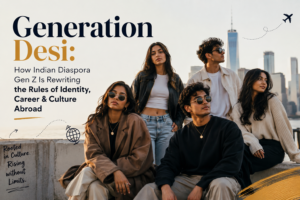
Coachella 2026: From appropriation to reclamation
Nothing illustrated this shift more vividly than Coachella 2026. Just over a decade ago, the California desert festival became infamous for cultural appropriation — celebrities sporting bindis and henna as “boho festival accessories,” triggering outrage from South Asian communities worldwide. This April, the narrative flipped entirely.
Young Indian American creators and influencers arrived at Coachella not to protest, but to own the space. Influencer Sheel debuted a half saree, bold bindi, and maang tikka of her own slow fashion brand Svarini — made in California and Delhi — in what became one of the most discussed looks of the festival weekend. K-pop star Lara Raj from KATSEYE, of Indian origin, made her Coachella debut in bindi and bangles, telling a generation of brown girls that visibility in mainstream culture is not just possible — it is intentional.
Fans described the South Asian visibility at Coachella 2026 as deliberate and coordinated. For Indian diaspora Gen Z, representation in mainstream spaces has become deeply personal — a statement that their culture is not an aesthetic to borrow, but a living identity to celebrate.

Career-first, but on their own terms
Indian Gen Z is the most career-driven of any youth demographic globally, according to research by Instagram and trend forecasting firm WGSN. Unlike their counterparts in the US, UK, or Brazil, young Indians — both in India and abroad — consistently rank career exploration as their top priority. But the definition of career has evolved dramatically.
Where their parents chased stable engineering or medical careers — the classic immigrant success template — Gen Z diaspora Indians are embracing entrepreneurship, creative industries, content creation, and tech startups with equal confidence. Research shows that Indian Gen Z believes starting a business is the best route to wealth, far more than any other national cohort surveyed. In the diaspora context, this translates into a wave of Indian-origin founders building companies across the US, UK, Canada, and Australia that blend global ambition with Indian cultural insight.
Studying abroad — smarter, not harder
India is the second largest source of international students globally, with over 620,000 enrolled in universities worldwide. But Gen Z Indian students are approaching study abroad differently from previous generations. The old model — arrive, study, get a job, stay — is being replaced by something more intentional. Today’s Gen Z Indian student travels with a clear strategy: build global networks, acquire intercultural skills, and return home or build cross-border careers that bridge India and the world.
Universities worldwide are responding by launching more flexible, hybrid, and experience-driven programmes that appeal to this generation’s desire for meaning alongside a qualification. Study abroad is no longer just about a foreign degree — it is about building a global identity.


Mental health: The conversation diaspora Gen Z is finally having
Perhaps the most significant shift of all is the one happening quietly, in therapy rooms and Instagram comment sections. Indian diaspora Gen Z is the first generation to openly confront the mental health toll of the immigrant experience — the model minority pressure, the cultural loneliness, the impossible expectations of excelling in a country that does not always see them fully.
South Asian mental health advocates, therapists, and creators online have built substantial audiences by naming these experiences honestly. The stigma around seeking help, while not gone, is lifting faster in the diaspora than anywhere else in the Indian cultural sphere. For a generation raised on authenticity as a value, emotional honesty is no longer weakness — it is identity.
What this means for India
India’s government and businesses are beginning to wake up to the reality that diaspora Gen Z is not just a source of future remittances. They are innovators, investors, cultural ambassadors, and political voices — in their host countries and increasingly in India too. The Indiaspora Forum 2026 in Bengaluru explicitly acknowledged that the next phase of India’s global rise depends on how well it engages this generation: not through nostalgia alone, but through opportunity, technology, and genuine inclusion.
Generation Desi is not waiting for permission. They are rewriting the story of what it means to be Indian in the world — one startup, one festival outfit, one therapy session, and one honest conversation at a time.

