
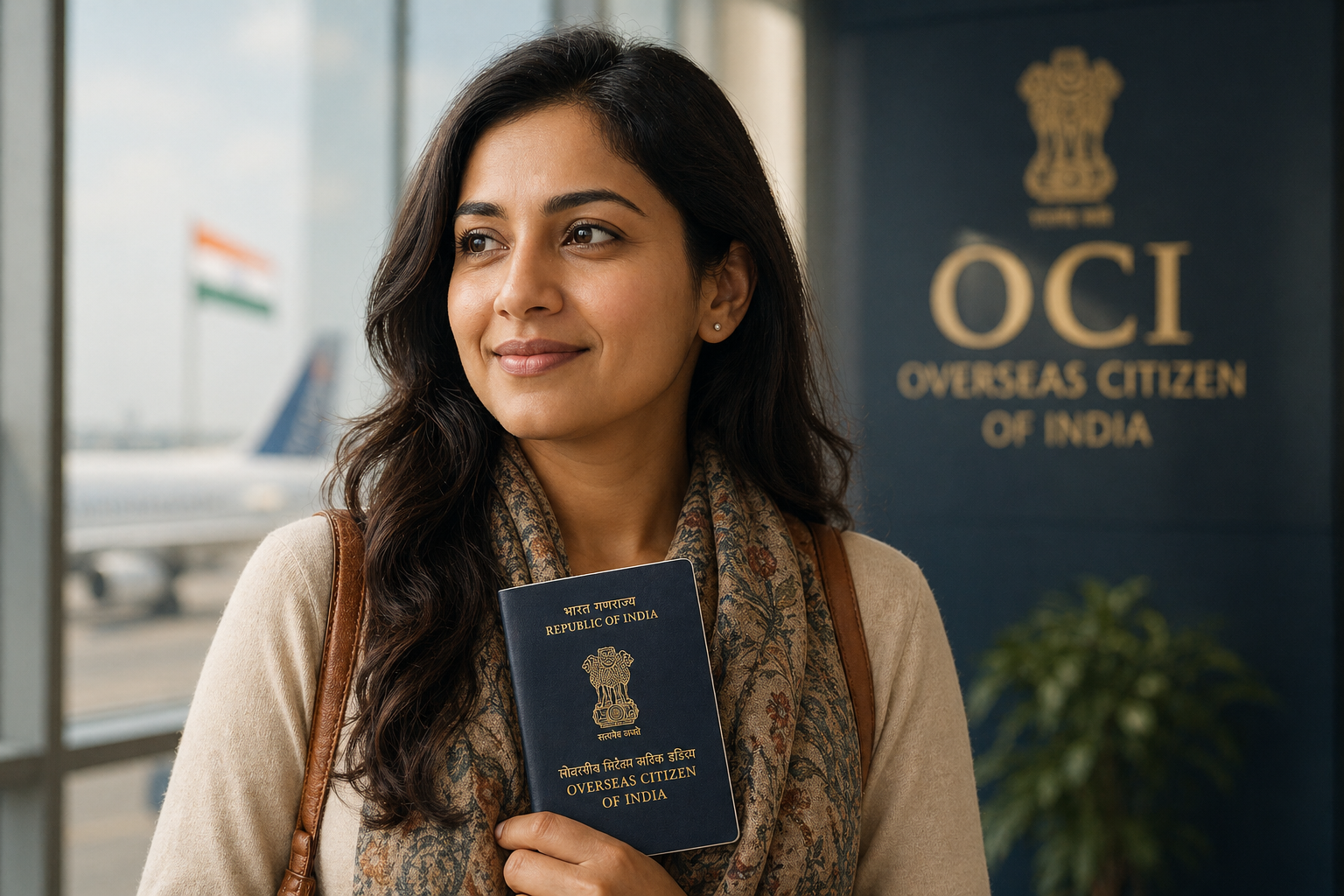
What the OCI actually is
The Overseas Citizen of India card, in plain language, is a lifetime visa to India that comes with most — but not all — of the practical rights of Indian citizenship.
It is a document, not a status. It does not make you a citizen of India. India does not permit dual citizenship; Article 9 of the Indian Constitution makes that explicit. An OCI card lets a foreign citizen of Indian origin enter, leave, live in, work in, study in, own most kinds of property in, and operate businesses in India without needing a visa or a residency permit.
That is a meaningful right. For a US citizen of Indian origin, it is the difference between needing to apply for a visa every time and walking through the Indian immigration counter with a card. For someone considering a long stay in India, it is the difference between a 180-day tourist visa and the freedom to live there indefinitely.
It is not, however, the same as being Indian.
What the OCI gives you
The substantive rights an OCI cardholder has, summarised:
- Multiple-entry, lifelong visa to India. No need to apply for a separate visa for any visit. You enter on the OCI card alongside your foreign passport.
- No registration with the FRRO for stays of any length. (Indian citizens and OCI holders do not register; foreign nationals on long-stay visas do.)
- Parity with non-resident Indians (NRIs) in most financial, educational, and economic fields. This includes opening NRE/NRO bank accounts, investing in mutual funds, and applying for the same fee structure at Indian universities.
- Right to acquire and own most kinds of immovable property in India — residential and commercial real estate.
- Right to work and operate businesses in most sectors, on the same terms as resident Indians.
- Right to practise most professions — medicine, law, chartered accountancy, architecture — subject to the same registration requirements as Indian citizens.
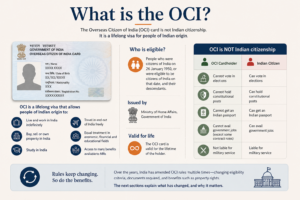
What the OCI does not give you
This is where most cardholders are surprised:
- You cannot vote. OCI cardholders have no franchise in any Indian election.
- You cannot stand for elected office. No Lok Sabha, no Rajya Sabha, no state legislature, no panchayat.
- You cannot hold a government job. Constitutional posts, civil service, judicial positions — all closed.
- You cannot acquire agricultural land, plantation property, or farmhouses in India. This is the single most common surprise for diaspora families inheriting ancestral land. You can hold inherited agricultural land in some circumstances, but you cannot purchase it.
- You need special permission for certain activities — research, mountaineering in protected areas, missionary work, journalism, and visits to certain protected and restricted areas. These require a separate clearance from the Ministry of Home Affairs.
- You do not get an Indian passport. You travel on whatever foreign passport you hold; the OCI card travels with it.
A short history of how we got here
The OCI scheme as it exists today is younger than many of the people using it.
For most of independent India’s history, the country took a hard constitutional line against any form of dual or recognised dual nationality. Citizens who naturalised abroad lost their Indian citizenship automatically. Generations of the diaspora — the families who left for East Africa in the 1950s, for the UK in the 1960s, for North America in the 1970s and 1980s — had no formal status with India once they took foreign passports. They returned as foreigners, on tourist visas.
Two schemes changed that:
The Person of Indian Origin (PIO) card, introduced in 2002, gave foreign citizens of Indian origin a 15-year multiple-entry visa, exemption from FRRO registration for short stays, and parity with NRIs in some financial matters. It was useful but limited.
The Overseas Citizen of India scheme, introduced in 2005, went further: lifelong validity, broader rights, the closer-to-citizen suite. It was framed at the time, including in then–prime minister Manmohan Singh’s announcements, as the strongest formal acknowledgement of the diaspora that the Indian state had ever offered.
In 2015, the Modi government merged the two schemes. PIO cards were converted to OCI status. There is now only one document.
That sounds like the end of a tidy story. It is not.
What India has changed since 2015 — and why most cardholders did not notice
The OCI is sometimes described as “lifelong” and “permanent.” Both descriptions are technically true and practically misleading. Several changes over the past decade have meaningfully altered what the card does and does not protect:
The 2021 notification. In March 2021, the Ministry of Home Affairs issued a consolidated notification that, in effect, downgraded OCI cardholders from being treated as “near-citizens” to being treated as “foreign nationals enjoying special privileges.” The shift was largely linguistic in the new text, but the practical consequences were real: OCI holders now formally require special permission from competent authorities for journalism, research, missionary work, mountaineering in protected areas, and visits to restricted regions including parts of the North-East, Sikkim, the Andaman & Nicobar Islands, and Jammu & Kashmir. Many of these restrictions had existed before in scattered form; the 2021 notification consolidated and re-emphasised them.
The passport-renewal rule. OCI cards must be re-issued every time the holder’s passport is renewed before they turn 20 years old, and once more after they turn 50. For a child whose passport is renewed every five years, this means multiple OCI re-issuances during childhood. The rule has been administratively simplified more than once but the requirement remains, and lapses can — at the discretion of immigration officers — cause real problems at the border.
Cancellation grounds. The OCI status can be cancelled. The grounds, set out in the Citizenship Act, include: registration obtained by fraud, disaffection towards the Constitution, engaging in war against India, imprisonment for a term of two years or more within five years of registration, and — the most discretionary — “if it is necessary in the interest of sovereignty and integrity of India, security of India, friendly relations of India with any foreign country, or in the interests of the general public.” The last clause is broadly worded and has been used to cancel OCI status of journalists, activists, and academics whose work the government has objected to. The number of cancellations remains small relative to the cardholder base, but the precedent is established and the trajectory is one of expanding rather than contracting use.
Surrender of Indian passport requirement. OCI applicants who were previously Indian citizens must formally surrender their Indian passport and obtain a “Surrender Certificate” before applying. Penalties for not having done so when one naturalised abroad have been imposed retrospectively in some cases — particularly on those who renewed Indian passports after acquiring foreign citizenship.
What this means in practice
For the great majority of OCI holders — the diaspora professional, the second-generation child returning to see grandparents, the retiree spending winters in India — the card works as intended. Walk through immigration. Live there if you want. Buy a flat. See your family.
For the smaller minority whose work or politics is in any way controversial — journalists, academics writing on contested topics, activists, occasionally artists — the OCI is no longer the secure status it was understood to be in 2005 and 2015. There have been documented cases of cardholders being refused entry, having their cards cancelled, or being deported. The legal recourse is limited.
For families with mixed-status children — one parent Indian, one foreign, children born abroad — the paperwork is unforgiving. Renewals must be tracked. Passport changes must be reported. Lapses can compound.
What to watch in 2026
Three things worth keeping an eye on, with the caveat that policy in this space moves quietly and often without major public announcement:
- The proposed OCI portal upgrade, which the Ministry of Home Affairs has been signalling for over a year, is supposed to consolidate the application, renewal, and miscellaneous-service workflows. As of early 2026 it had not fully replaced the existing system; check the consulate or VFS website for your jurisdiction before relying on either.
- Any new categories of activity requiring special permission. The 2021 notification was an expansion of an existing pattern, not the end of it. New restrictions are typically issued by notification rather than by new legislation.
- The pending litigation around OCI cancellation procedures. Several constitutional challenges to the discretionary cancellation power are currently working their way through the Indian courts. The outcomes will materially affect what the card means.
A practical checklist
If you have an OCI card or are thinking of applying:
- Verify that your passport details on the OCI card match your current passport. A mismatch is the single most common cause of immigration headaches at Indian airports.
- If your passport has been renewed and you are under 20 or over 50, file for OCI re-issuance — do not assume the card “still works.”
- Do not buy agricultural land in India under your OCI status. Speak to an Indian advocate before any rural property transaction.
- If you intend to do journalism, research, or work in any region designated protected or restricted, apply for the relevant permission well in advance.
- Keep your OCI card and passport together when travelling to India. Carry the OCI card on the return leg of any trip — some airlines outside India insist on seeing it before boarding.
The OCI is the single most useful document India offers its diaspora. It is also a document the Indian state has retained the right to alter. Treating it as the first and trusting it not to change is the mistake most cardholders make. Treating it as a privilege to be maintained, renewed, and stayed informed about is the more honest posture.

