
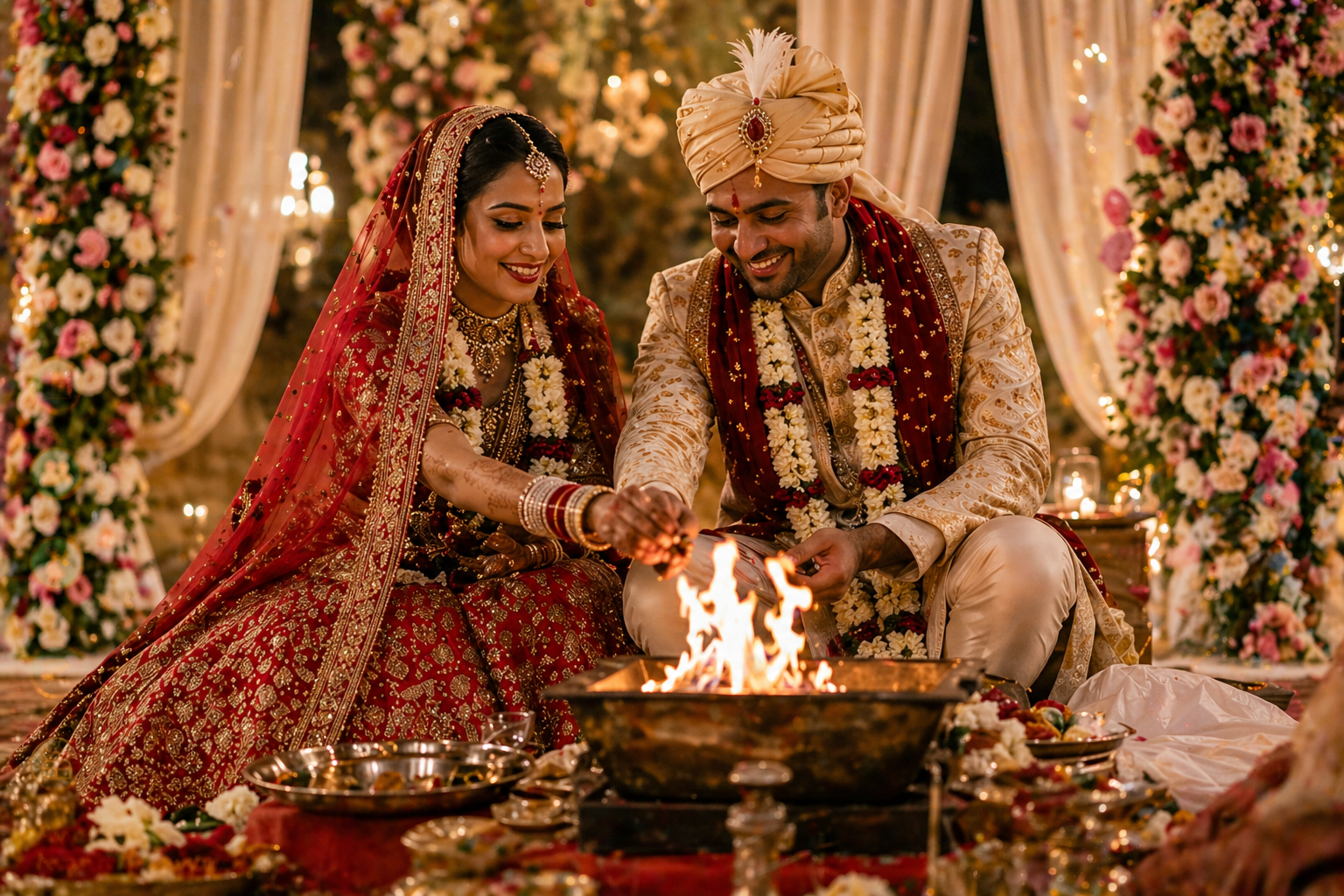
The Edison wedding
The Patel wedding I went to in Edison last summer had 1,400 guests, two days of pre-events, a sangeet rehearsed by a choreographer who flies in from Mumbai, and a baraat that got the local police to block off Oak Tree Road for forty minutes. It also had the most Gujarati I had heard spoken in any single weekend of my life. I am thirty-three. I had not heard it spoken in that density since I was a child.
By Sunday evening, when the after-party had cleared and the cousins were arguing in the parking lot about who would carry the leftover mithai home, it occurred to me that the wedding had been, for those four days, the most Indian thing in everyone’s life — including the lives of people for whom being Indian was supposedly already a daily condition.
The Monday silence that followed was the more honest one.
This is the thesis of this essay, which I will state once and then defend at length: the Indian diaspora has quietly outsourced the work of being Indian to weddings. Language, religion, food in its non-restaurant form, the obligation to remember who is whose mother’s brother and sit next to them at lunch — all the daily habits that once made a person Indian have collapsed into one event you stage every few years. The wedding has become the country.
What used to be daily
It is worth being specific about what has shrunk.
There was, within living memory, a way of being Indian abroad that did not depend on weddings, because the daily life provided enough.
First-generation households — by which I mean the families that arrived in the UK in the 1960s, in North America in the 1970s and 1980s, in the Gulf throughout — sustained Indianness through accumulation. The temple on Sundays. The Saturday-morning Tamil class for the children. The samosa-fundraising for the community centre. The aunties who came over with tiffins. The arranged dinners at which someone’s prospective in-laws were being inspected. The phone calls home that lasted forty-five minutes and ended with everyone crying. The grandparents on the line. The newspaper that came in the post. The sari that had to be ironed properly for the function on Friday. The gold jewellery the value of which you knew by feel.
None of it was special. That was the point. None of it required a planner. The work of being Indian was carried by an entire week of small, repetitive, slightly tedious gestures, none of which photographed well, none of which would be Instagrammed, none of which made the second-generation child think this is a moment. Most of it made the second-generation child want to escape — out of the kitchen, out of the temple, out of the language class, into the suburbs of being just a kid like the others.
This is the great irony of the diaspora cultural conversation. The generation that wanted out of all of it — out of the Saturday school, the temple committee, the function — is the same generation now staring at its own children and wondering why they do not speak Tamil and why the Diwali pooja is just three of you in a basement and why the grandmother in Coimbatore sounds, on the phone, like a stranger.
The wedding as compressed Indianness
The wedding stepped in when the daily life thinned out.
This was not a deliberate substitution. Nobody decided. It happened the way large cultural changes happen — incrementally, by everyone making the same individual decisions for the same individual reasons. The temple Sundays got harder when soccer practice was on Sundays. The Tamil class got quietly dropped after the SATs got serious. The aunties stopped coming over with tiffins because the aunties’ children were in college themselves and the aunties were now driving them to soccer practice. The community centre dwindled. The grandparents died. The newspaper went online. The sari got worn once a year, then once every two years.
But the wedding remained. And as everything else got smaller, the wedding got bigger. It got bigger because everything else getting smaller meant that the wedding now had to do the work that the daily life used to do.
You can see this in the proportions. A typical first-generation wedding in 1975 in Leicester or Edison was a one-day event, maybe 200 people, a single ceremony plus a meal, costing roughly the equivalent of three months of the father’s salary. A typical second-generation wedding in 2005 was a two-day event, perhaps 400 people, with a separate sangeet and reception, costing roughly a year of one income. A typical third-generation wedding now — and there are plenty of third-generation weddings, in Houston and Hounslow and Toronto and Singapore — is a four-to-five-day event, 600 to 1,500 people, with a sangeet, a mehendi, a haldi, a ceremony, a reception, often a separate after-party, costing somewhere between USD 200,000 and USD 750,000 in middle-class American terms. There are wedding planners specifically advertised as “Indian-American wedding specialists.” There are mandap-rental companies. There is a Mumbai-based choreographer industry that flies in for the sangeets.
The line is not subtle. The wedding has expanded in inverse proportion to the daily.
Five communities, one pattern
This is not a Gujarati phenomenon, or a Punjabi one. It is happening across the diaspora, in different aesthetic registers but the same underlying shape.
The Patel wedding in New Jersey expands into the four-day Hindu format with a Garba night and a baraat. The Tamil wedding in Toronto expands into a two-day Brahmin ceremony preceded by a sangeet borrowed (a generation ago, with mild controversy; now without comment) from the North Indian playbook. The Punjabi wedding in Surrey or Brampton has been the four-day complex for longer than any other community and is now expanding upward into destination weddings in Mexico and Italy. The Bengali wedding in Houston has acquired, in the last fifteen years, a pre-wedding sangeet that the bride’s grandmother in Kolkata would not have recognised. The Malayali wedding in Dubai or Houston, traditionally one of the simpler ceremonies in the Indian repertoire, now routinely runs to two days and includes a “sit-down dinner reception” lifted from the standard American template.
The aesthetics differ. The compression is the same. Each community is doing more wedding than it used to, in more days, for more guests, with more vendors — in inverse proportion to how much the rest of the year carries the cultural work.
The professionalisation
The wedding has, in the last two decades, become an industry. This is the part that is both the most predictable and the least examined.
A diaspora Indian wedding is now, in operational terms, a small corporate event. There are planners. There are decor companies. There are sangeet choreographers — who, for the record, charge somewhere between USD 5,000 and USD 25,000 to choreograph two evenings of dances. There are mandap-rental companies whose websites have category filters by region. There are Indian-American photography teams whose entire business is built on the four-day format. There are catering operations that have been doing this for two generations, who can produce 800 dosas in three hours. There is a videographer-and-edit pipeline that delivers a wedding film of the kind that used to belong to actual feature productions. There is a wedding-card printer who knows, by region, which conventions apply.
This professionalisation is what makes the modern diaspora wedding work, and it is also what is doing the slow, almost imperceptible damage. Because the more professional the wedding becomes, the less is asked of the family.
In 1975, an aunt did the cooking. In 1995, three aunts and a cousin did the cooking. In 2025, no aunt does the cooking. The aunt is at the function in a sari and is being seated at a table, where she will be served dosas by a vendor who is excellent at making dosas but who is not her sister-in-law. The cooking, the decor, the music — all the things that the family used to actually do together, which were the actual work of being a family in public — are now being done by paid professionals while the family arranges itself for photographs.
This is the part of the modern diaspora wedding that the families themselves notice and grieve. It is the part the planners do not put in the brochure.
What gets lost when culture compresses
A culture that has been compressed into one event has lost certain things that cannot be recovered by making the event larger.
It has lost ordinariness. The grandmother who comes over to teach you how to fold a samosa wrapper without it splitting is not at the wedding. She is at home, in Surat or Coimbatore or Mehsana, in a flat her children do not visit often enough. The wedding is when you fly in to see her. The wedding is also when you discover that you have nothing to talk to her about, because the daily ordinariness that would have given you something to talk to her about was outsourced ten years ago.
It has lost the medium-stakes practice. The first-generation child who attended the temple every other Sunday picked up a passable working Hindi or Tamil or Gujarati without anyone particularly trying. The third-generation child who attends one Diwali pooja a year plus one wedding every three years picks up nothing — and is then expected, on the wedding day, to participate in a ritual whose meaning has not been transmitted across the year. The result is the third-generation cousin standing through the saptapadi with a polite, attentive, and entirely alien expression, performing reverence to a thing they do not actually know.
It has lost the texture of obligation. The reason an Indian wedding has, historically, taken four days is that the wedding was meant to be the visible, public ratification of a much larger and longer set of family obligations that already existed and would continue to exist. You went to your cousin’s wedding because you had been at your cousin’s first birthday and your cousin’s school admission and your cousin’s mother’s recovery from a hospital stay. The wedding was one entry in a long ledger of mutual presence. Now, in the diaspora, it is often the only entry. The cousin you have not seen in seven years is going to invite you to their wedding and you are going to fly in for it, because the wedding is the only ledger left.
What it gives back, honestly
I am about to undercut my own thesis, briefly, because the wedding does in fact give something back. To pretend otherwise would be to pretend that grown adults in the diaspora are doing this for no reason.
The wedding produces, every few years, three days of something the diaspora child does not otherwise have access to: a critical mass of their own community in one room. A wedding of 800 people is the only context in which a thirty-year-old Tamil-American from Atlanta has ever been in a room of 800 other Tamils. It is, for many people, the only context they ever will be. There is a real cultural transmission that happens in those rooms — not in the formal ceremony, which most attendees have stopped following, but in the in-between moments. The grandmother corner. The kitchen corner. The cousins arguing in three languages about whose mehendi is darker. The uncle telling the story about the village that the parents have stopped telling. This is real. It is not nothing.
The wedding also reactivates the WhatsApp groups, the family ones, that go silent the rest of the year. It produces six months of pre-wedding planning in which, for the first time since the last wedding, your mother and her sister and her cousin are actually talking to each other every day. It produces the photographs that, in twenty years, will be the only documentary record the next generation has of an extended family that has otherwise dispersed across four continents.
So: not all loss. Real, durable cultural work is happening at these weddings, and to dismiss it as performance is to misunderstand both the people doing it and the conditions under which they are doing it.
The honest position is that the wedding is doing real work, and is doing a fraction of the work that the daily life used to do, and is being asked to do more than any single event can carry.
The third-generation question
This is the question worth ending on. It is also the question that the wedding-industrial complex would most prefer the diaspora not ask too loudly: what happens when the wedding too becomes so professionalised that even the wedding stops doing the cultural work?
I will tell you what I think happens. I think you arrive at a moment, somewhere around the fourth generation, when the wedding is so completely outsourced that even it does not transmit anything. The planner picks the rituals. The choreographer picks the songs. The caterer picks the menu. The decorator picks the colours. The grandmother is no longer present; or if she is present, she is being asked to bless the proceedings, not to direct them. The wedding film looks identical to every other wedding film, because the same five photography teams are shooting all of them. The next generation grows up watching their parents’ wedding film and learns nothing about the culture from it that they could not have learned from a Bollywood movie — because in operational fact the wedding has been styled to resemble a Bollywood movie.
That is the moment when the wedding stops being the country and starts being the brochure of the country. There is a difference. The brochure does not transmit. The brochure markets.
This is not yet where we are. Most diaspora families are still inside a version of the wedding where some of the actual cultural work is happening — usually because there is still a grandmother present, or a great-aunt, or one uncle who insists on doing the bhajans the old way and embarrasses the planner. As long as that figure is in the room, the wedding is still doing its compressed cultural work.
When that figure goes — and that figure is going, in the natural order of things, generation by generation — the wedding will be the photographs and nothing else.
A close
I am not arguing for any particular response to this. The diaspora cultural conversation has a tendency to end in prescriptions — send your child to the temple, learn the language, marry within, do not outsource the cooking — most of which are unhelpful, some of which are insulting, and all of which underestimate how much has already changed.
What I am arguing is that the wedding, in the diaspora, is doing more cultural work than any single event in any culture has historically been asked to do. It is doing the work of the temple, the language class, the daily kitchen, the extended family Sunday lunch, the village festival, and the religious calendar — all compressed into one four-day event that recurs once every few years. We have, collectively, decided that this is what we can manage. We are not wrong about what we can manage. We are also, possibly, not honest with ourselves about what one wedding can carry.
The Patel wedding I went to in Edison last summer was beautiful. The bride wept in three languages. The grandmother gave a speech in Gujarati that nobody under thirty understood and everyone over fifty agreed afterwards was the best speech of the weekend. A cousin I had not seen since 2014 hugged me for a long time, said yaar, and went back to his table.
Then it was Monday, and everyone went home, and the Indianness of all our individual lives went back to being whatever shape it had been before the wedding started.
The wedding became the country. The Monday is the country we actually live in.

