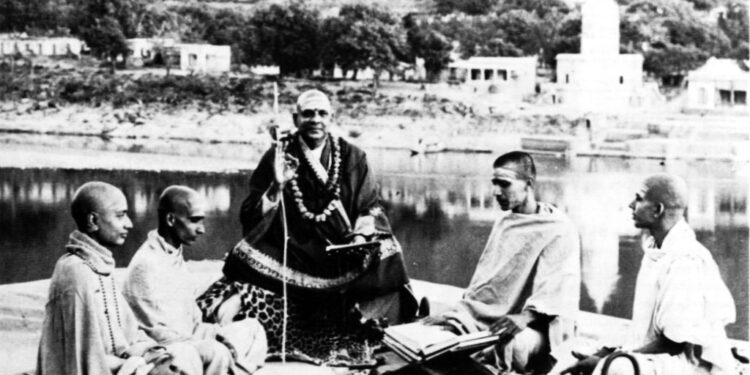
Swami Vivekananda and the sentence that opened the West
Part 1 of The Masters Who Crossed the Ocean. On 11 September 1893, a young Bengali monk walked onto a Chicago stage and began, 'Sisters and brothers of America.' The ovation that followed marked the moment India's spiritual tradition went global.
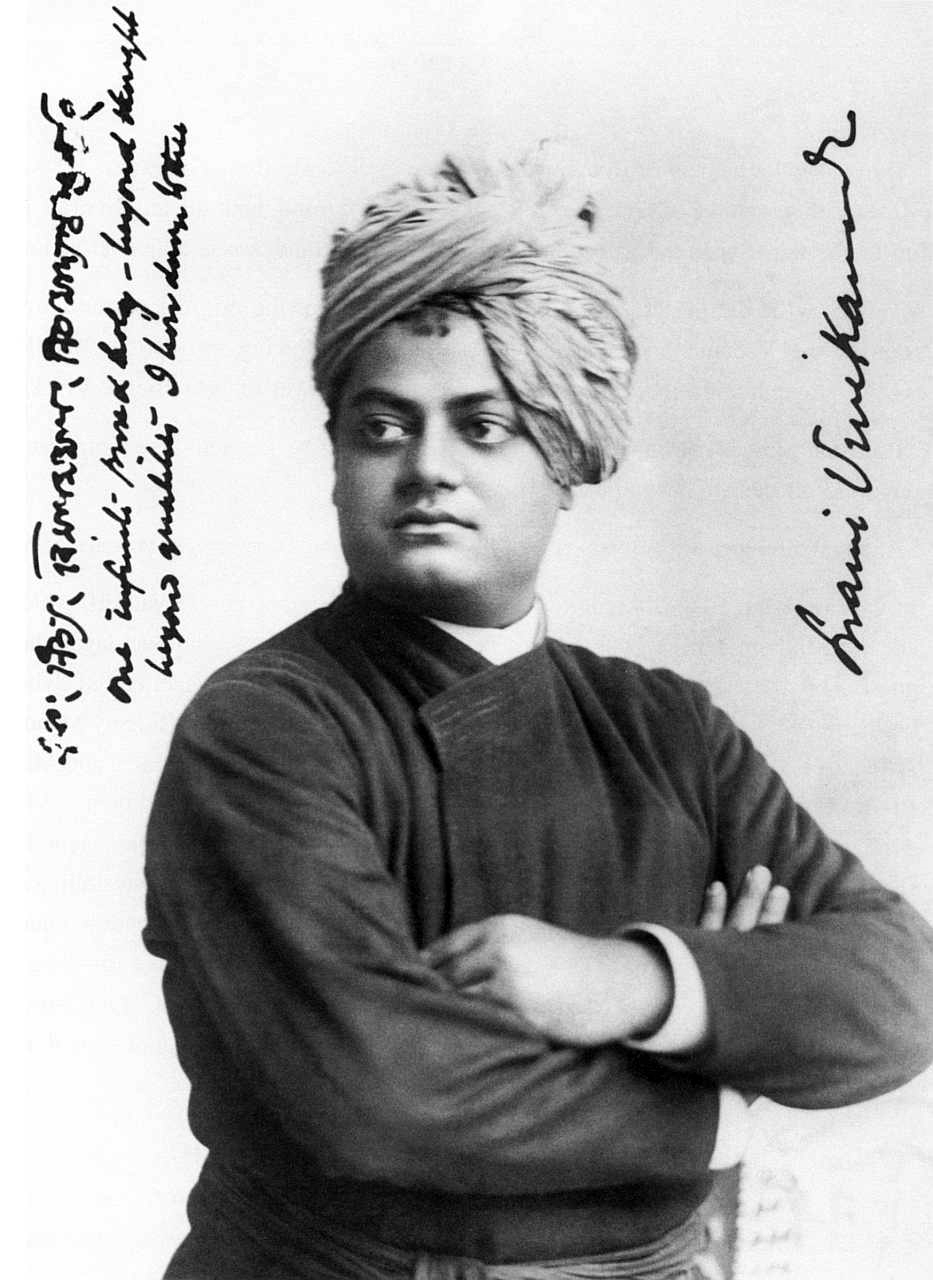
The Masters Who Crossed the Ocean — Part 1 of 12.
On the morning of 11 September 1893, a thirty-year-old monk from Bengal rose to address the Parliament of the World's Religions, held at the Art Institute of Chicago. He had no formal delegation behind him, little money, and no organisation. He opened not with doctrine but with four words — "Sisters and brothers of America" — and, by the standard accounts, some seven thousand delegates rose in a roughly two-minute standing ovation before he had made a single argument.
That moment is where this series begins. The globalisation of yoga and Indian spirituality is usually told as a Western discovery. It was not. It began with a handful of Indian masters who physically crossed the ocean and argued for their tradition on foreign soil. Swami Vivekananda was the first to do it at this scale.
From Narendranath to Vivekananda
He was born Narendranath Datta on 12 January 1863 in Calcutta, into an educated, comfortable Bengali family, as Encyclopaedia Britannica records. A sharp, sceptical student at home in Western philosophy and logic, he was drawn in 1881 to the mystic Ramakrishna, the priest of the Dakshineswar Kali temple. After his own father's death in 1884 left the family in financial difficulty, he made Ramakrishna the centre of his life. When the saint died in 1886, the young disciple took monastic vows, adopted the name Vivekananda, and spent years wandering the length of India on foot, an unknown beggar-monk.
The crossing
It was that obscure wanderer who arrived in the United States in 1893. What he offered the Parliament was not a bid for converts but a Vedantic case for tolerance and universalism — the idea that the world's religions were many rivers running to one sea. The American press seized on him, and he spent much of the next three years lecturing across the country. In 1894 he founded the Vedanta Society of New York, one of the first lasting institutional footholds for Indian philosophy in the West.
The book that reframed yoga
In 1896 he published Raja Yoga, an interpretation of Patanjali's Yoga Sutras written for a Western reader. Its influence is hard to overstate: it helped plant an idea that now seems obvious but was then radical — that yoga was a practical, universal discipline available to anyone willing to work at it, not the closed inheritance of one culture or caste. Almost every master profiled later in this series worked in the space that book helped open.
Home again — and a short life
Vivekananda did not stay an exile. Back in India, on 1 May 1897 he founded the Ramakrishna Mission, fusing spiritual practice with hard social service — schools, hospitals, famine relief — under the banner of karma yoga, selfless work as a path. He established its headquarters at Belur Math on the bank of the Ganga, where the order remains today.
He did not live to see what he had started. He died at Belur Math on 4 July 1902, aged just thirty-nine. In barely nine years of public life he had done something no Indian had managed before: he made the country's spiritual inheritance legible, and respectable, to the West — and opened the door that Yogananda, the Maharishi, Prabhupada and the others in this series would later walk through.
Next in the series: Paramahansa Yogananda, whose_ Autobiography of a Yogi _turned a Himalayan lineage into an American bestseller.
Sources: Encyclopaedia Britannica · Wikipedia: Swami Vivekananda · Ramakrishna Math and Mission, Belur Math.
Continue the series · The Masters Who Crossed the Ocean
← About the series
The Masters Who Crossed the Ocean
Next · Part 2 (coming soon)
Paramahansa Yogananda — the autobiography that sold the East
Related from Yoga & Spiritualism

Yoga for Healthy Ageing: diaspora marks Yoga Day 2026 from the Lincoln Memorial to Times Square
Healing, Conscious Living & Transformational Retreats
The Light from the Himalayas: The Journey of Swami Prakasananda Maharaj